Abstract Code: IUC25511-79
Prostate volume changes during longer fractionated and ultra-hypofractionated MR-guided adaptive radiotherapy leveraging the MOMENTUM registry
- Cooper 1, H. Akhiat 2, S. Alexander 1, F. Alongi 3, E. Blezer 4, A. Choudhury 5, J. Christodouleas 2, J. Diaz 1, C. Gani 6, S. Hafeez 1, W. Hall 7, P. Jeene 8, M. Luzzara 1, M. Nowee 9, T. Schytte 10, H. Verkooijen 9, D. Vesprini 11, J. Van Der Voort Van Zyp 4, P. Westhoff 12, A.C. Tree 1
(1) Royal Marsden NHS Foundation Trust / Institute of Cancer Research, London – United Kingdom, (2) Elekta, Stockholm – Sweden, (3) IRCCS Ospedale Sacro Cuore-Don Calabria, Cancer Care Center, Negrar Verona – Italy, (4) University Medical Center Utrecht, Utrecht – Netherlands, (5) Division of Cancer Sciences, University of Manchester / The Christie NHS Foundation Trust, Manchester – United Kingdom, (6) Universitätsklinikum Tübingen, Tübingen – Germany, (7) Medical College of Wisconsin / Froedtert Hospital, Milwaukee – United States, (8) Radiotherapiegroep, Deventer/Arnhem – Netherlands, (9) Netherlands Cancer Institute – Antoni van Leeuwenhoek, Amsterdam – Netherlands, (10) Odense University Hospital, Odense – Denmark, (11) Sunnybrook Health Sciences Centre, Toronto – Canada, (12) Radboud Universitair Medisch Centrum, Nijmegen – Netherlands
Purpose/Objectives:
Prostate volume changes during radiotherapy may compromise target coverage [1,2]. We quantified longitudinal swelling across longer fractionation (≥15 fractions)(LFRT) [3] and stereotactic body radiotherapy (SBRT) regimes during MR-guided adaptive radiotherapy (MRgART) to identify predictors of clinically significant swelling (CSS, defined as ≥15% volume increase) [4,5].
Materials/Methods:
This multicentre prospective cohort study analysed patients treated on an MR-Linac between January 2020-April 2025 enrolled in MOMENTUM [6]. Inclusion mandated daily recontouring/adaptation with ≥3 fractions available. Structure volumes were extracted using PyRadiomics (v3.0.1). A hierarchical fuzzy-matching algorithm (Levenshtein distance) harmonised prostate volume nomenclature across centres. Clinical and demographic variables were collected, and fraction 1 counted as baseline volume [7]. Proportion of treatment spent with CSS was normalised to number of fractions. Baseline prostate volume was dichotomised. Linear mixed-effects models (LMM) quantified continuous volume trajectories by cohort. Multivariable logistic regression tested predictors of CSS as a binary outcome.
Results:
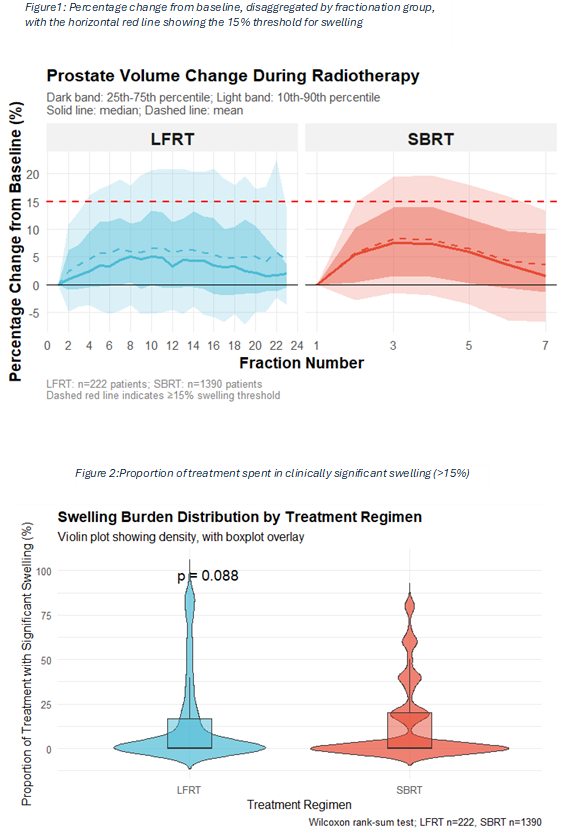
From 1907 patients, 222 LFRT and 1390 SBRT patients met eligibility. A total of 10297 fractions were analysed (median 20 for LFRT, 5 for SBRT patients), with median baseline prostate volume of 40.0 cm³ (IQR 28.9-53.6) for LFRT and 47.5 cm³ (IQR 35.8-66.0) for SBRT. Incomplete age data excluded 160 patients from LMM. CSS occurred in 15.2% LFRT and 13.1% SBRT total fractions (figure 1), but SBRT patients spend a higher proportion of treatment in CSS (figure 2). In LMM, larger baseline prostate volume was associated with reduced mean swelling in SBRT (β=-0.030% per cm³, p<0.001) but not LFRT (p=0.30). However, logistic regression showed larger baseline volume was protective in both cohorts (LFRT: OR 0.38, 95% CI 0.32-0.46; SBRT: OR 0.80, 95% CI 0.69-0.92). In secondary complete-case analysis including ADT and T-stage data (n=116 LFRT, n=256 SBRT), no significant association with ADT was observed in either cohort (LFRT p=0.65; SBRT p=0.37), whilst T2-stage disease was associated with increased swelling in SBRT (β=+3.0%, p=0.018) compared to T1-stage.
Conclusion:
SBRT patients experience a faster onset of prostate swelling compared to LFRT. Smaller baseline volumes and T2-stage was associated with increased swelling risk. Incomplete clinical covariate data limits definitive risk stratification, supporting continued fraction-by-fraction adaptive workflows.
Figures