Abstract Code: IUC26693-91
CHOLESTEROL HOMEOSTASIS AND IMMUNE-INFLAMMATORY PROFILES IN PATIENTS WITH mRCC RECEIVING IMMUNOTHERAPY
- P. Tuttobene 1, M. Maffezzoli 2, G. Leali 1, M. Pluchino 3, E. Favari 4, G. Mazzaschi 3, F. Pecci 3, M. Tiseo 3, M. Di Maio 5, S. Buti 3
(1) Department of Medicine and Surgery, University of Parma, Parma, Italy - Italy, (2) Medical Oncology Unit, University Hospital of Parma, Parma, Italy - Italy, (3) Department of Medicine and Surgery, University of Parma, Parma, Italy; Medical Oncology Unit, University Hospital of Parma, Parma, Italy - Italy, (4) Department of Food and Drug, University of Parma, Parma, Italy - Italy, (5) Medical Oncology 1, AOU Città della Salute e della Scienza di Torino, Turin, Italy - Italy
ACKNOWLEDGEMENTS: Project funded by the European Union - NextGenerationEU, Mission 4 Component 1, Unique Project Code (CUP): D53D23013940006
OBJECTIVE: Cholesterol metabolism may modulate antitumor immunity, influencing response to immune-checkpoint inhibitors (ICIs). We evaluated cholesterol transport-related biomarkers, KIM-1, and inflammatory mediators in metastatic renal cell carcinoma (mRCC) patients treated with first-line ICI-based regimens, to characterize the immune–metabolic profiles.
METHODS: LINCHOLM is a prospective, multicentre, observational study. Patients with mRCC receiving ICI-based combinations underwent blood collection at baseline, week 6 and progression. ABCA1- and ABCG1-mediated cholesterol efflux (CE), lipid fractions, and inflammatory mediators were assessed. Primary objective was to investigate associations between baseline cholesterol transporters and inflammatory mediators, and progression-free survival (PFS).
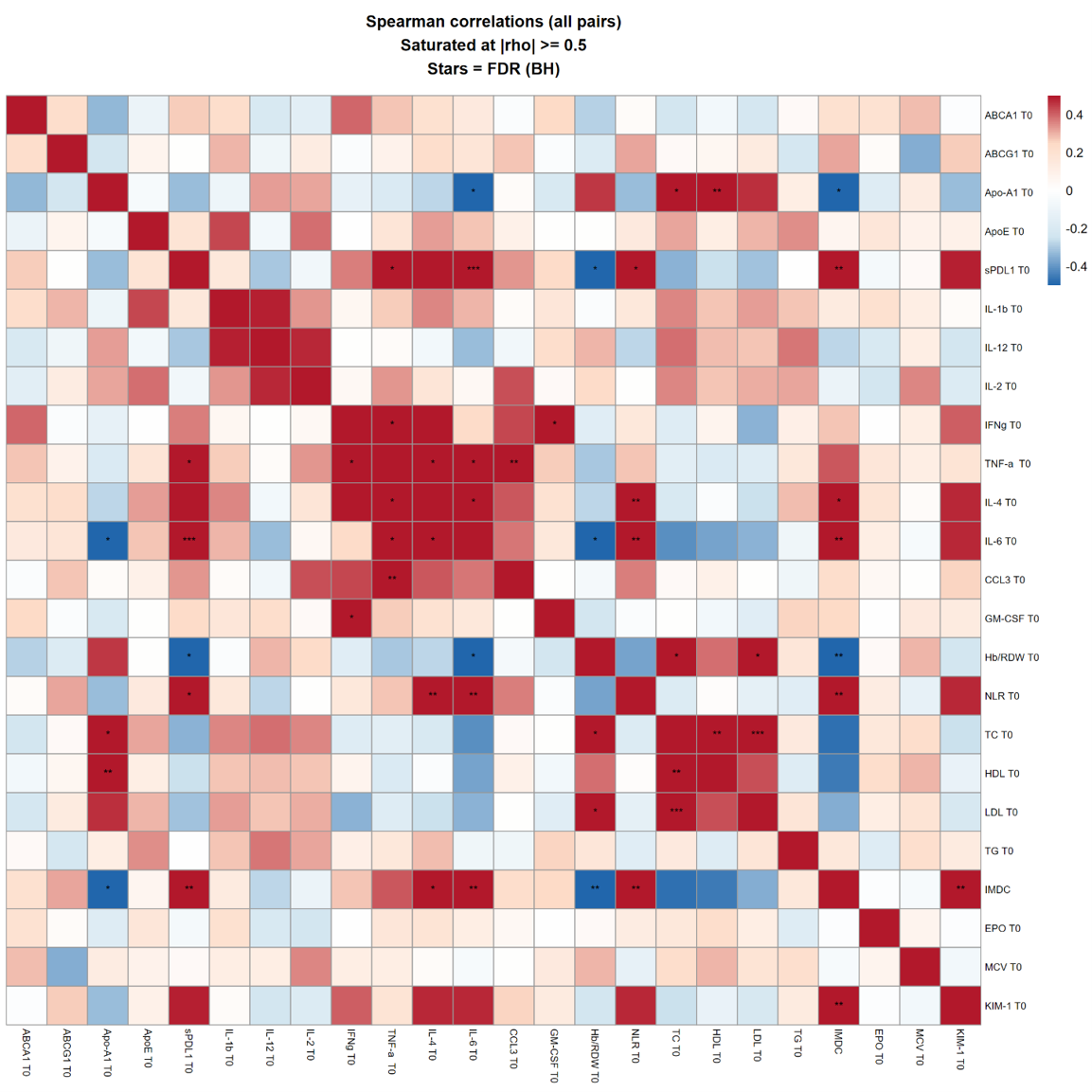
RESULTS: 33 patients were included, 84.8% had ECOG PS 0-1. Across worsening IMDC risk groups Apo-A1, total cholesterol, HDL and LDL decreased (all p≤0.03), whereas KIM-1, IL-6 and Apo-E increased (all p≤0.02). High ABCG1-mediated CE correlated with higher levels of ApoE and IL-1β (all p≤0.04). High KIM-1 was associated with poorer ECOG PS, synchronous metastatic disease, and higher NLR, IL-4, IL-6, and IL-10 (all p≤0.04), Figure 1. High baseline ABCG1-mediated CE, KIM-1, ApoE, NLR, and inflammatory cytokines (IL-4, IL-6, IFN-γ, IL-10, IL-1β, IL-2, and TNF-α) correlated with shorter PFS, Table 1. Only ABCG1 remained independently associated with worse PFS at multivariable analysis (HR 10.61, 95%CI 2.35–47.97; p=0.002), although estimates were limited by small sample size.
CONCLUSIONS: ABCG1-mediated CE may serve as a prognostic biomarker in mRCC patients receiving first-line ICI-based therapies. The interplay among cholesterol metabolism, KIM-1, and inflammatory mediators suggests a biological profile influencing outcomes and warrants further validation.
Table 1. Selected biomarkers significantly associated with PFS.
| Variable | Low group, median PFS, months (95% CI) | High group, median PFS, months (95% CI) | p-value |
| ABCG1 | 12.07 (6.81–NE) | 1.81 (1.15–NE) | <0.001 |
| NLR | 16.09 (7.07–NE) | 2.57 (1.45–NE) | 0.008 |
| KIM-1 | 16.09 (7.53–NE) | 2.62 (1.45–NE) | 0.002 |
| ApoE | 12.07 (6.81–NE) | 1.51 (0.89–NE) | <0.001 |
| IL-6 | 12.07 (6.78–NE) | 1.45 (1.18–NE) | 0.009 |
| IL-1β | 12.07 (6.81–NE) | 1.22 (1.15–NE) | 0.002 |
| TNF-α | 12.07 (6.81–NE) | 1.64 (1.25–NE) | 0.002 |
Figure 1. Heatmap of correlations between baseline biomarkers.