
Abstract Code: IUC26683-90
BlAdder Cancer Circulating biomarkers after treatment exposUre for early detection of relapse: The BACCUS study
- Mills 1, A. Bertocchi 2, P. Rescigno 3, J. Frew 4, R. Chandler 4, X. Jiang 4, L. Hogarth 4, M. Mukhiya 4, V. Conteduca 5, F. Demichelis 6
(1) School of Biomedical, Nutritional and Sports Science, Newcastle University, Newcastle upon Tyne – United Kingdom, (2) Department of Biomedical Sciences, Humanitas University, Milan – Italy, (3) Translational and Clinical Research Institute, Newcastle University, Newcastle upon Tyne – United Kingdom, (4) Northern Centre for Cancer Care, Newcastle upon Tyne – United Kingdom, (5) Department of Medical and Surgical Sciences, University of Foggia, Foggia – Italy, (6) Department of Cellular, Computational and Integrative Biology, University of Trento, Trento – Italy
Bladder cancer recurrences are detected using traditional, imaging-based techniques. Although of great interest, methodologies utilizing circulating tumour DNA (ctDNA) as a diagnostic tool have not yet been approved in this setting but have been found to correlate to recurrence or disease response, in a research setting, in patients who underwent radical cystectomy (RC).
BACCUS is a monocentric, observational trial aimed to evaluate ctDNA as a biomarker for detection of bladder cancer recurrence, before standard follow-up procedures, and to identify prognostic factors for relapse. In addition, ctDNA could allow for increased understanding of the genetic landscape of this heterogenic disease.
Muscle invasive bladder cancer (MIBC) patients (T2-T4 N0-N1 M0) with an ECOG PSs of 0-2 undergoing curative-intent chemo-radiotherapy are eligible.
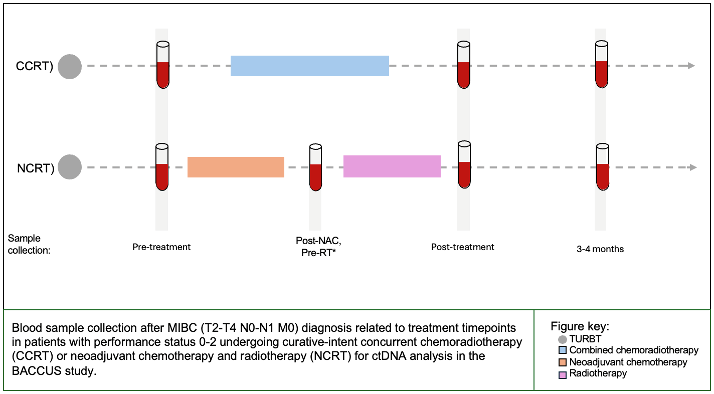
Whole blood samples are collected at baseline before any treatment, after chemotherapy (defined as NACT) for patients who start the systemic treatment before radiotherapy, after the completion of the radiation treatment and 3-4 months after the completion of the treatment. Timepoints are selected for optimal longitudinal observation of ctDNA dynamic changes over the course of treatment. Patient records will be monitored for 3-years while undergoing standard of care follow-up.
Figure 1: A depiction of sample collection in relation to treatment timepoints (not to scale)
Archive tumour samples from trans-urethral resection (TURBT) will undergo genetic analysis to serve as comparison. Plasma samples will undergo a double centrifugation protocol for plasma separation and ctDNA extraction will be carried out using the QIAGEN QIAamp Circulating Nucleic Acid kit, then sequenced using the PCF_SELECT protocol. The selected panel covers common genitourinary tumour alterations and actionable therapeutic targets and is specifically designed to detect the nature of mutations present and copy number alterations/allelic imbalance in samples with low ctDNA fractions.
Our hypothesis is that minimally invasive profiling of bladder cancer with ctDNA would enable earlier intervention and targeted therapy opportunity in case of progression or recurrence of the disease.