Abstract Code: IUC26569-93
Enfortumab-Vedotin with Pembrolizumab vs platinum-based therapy for advanced urothelial cancer in Oxford.
- Al Kharusi 1, S. San Ti 1, A. Protheroe 1, M. Tuthill 1
(1) Oxford University Hospitals NHS Foundation Trust – United Kingdom
Objective
Enfortumab-vedotin with pembrolizumab (EVP) was NICE approved in September 2025 and evidence in the seminal EV302 trial showed that it has doubled both progression free survival and overall survival in comparison to platinum-based therapy i.e. Gemcitabine with Cisplatin or Carboplatin (GemCisCarbo) in previously untreated advanced or malignant urothelial carcinoma. This study aims to investigate real world outcomes of EVP use in Oxford University Hospitals NHS Foundation Trust (OUH) in comparison to a retrospective control group of Gemcitabine with Cisplatin or Carboplatin patients. Additionally, we have investigated the safety profile of EVP in the local OUH cohort since September 2025.
Methods
We have investigated all patients who started on EVP for advanced urothelial cancer at OUH from October 2025 to April 2026 compared with a similar cohort of patients treated with Gemcitabine with Cisplatin or Carboplatin pre-EVP approval from July to October 2025.
Results
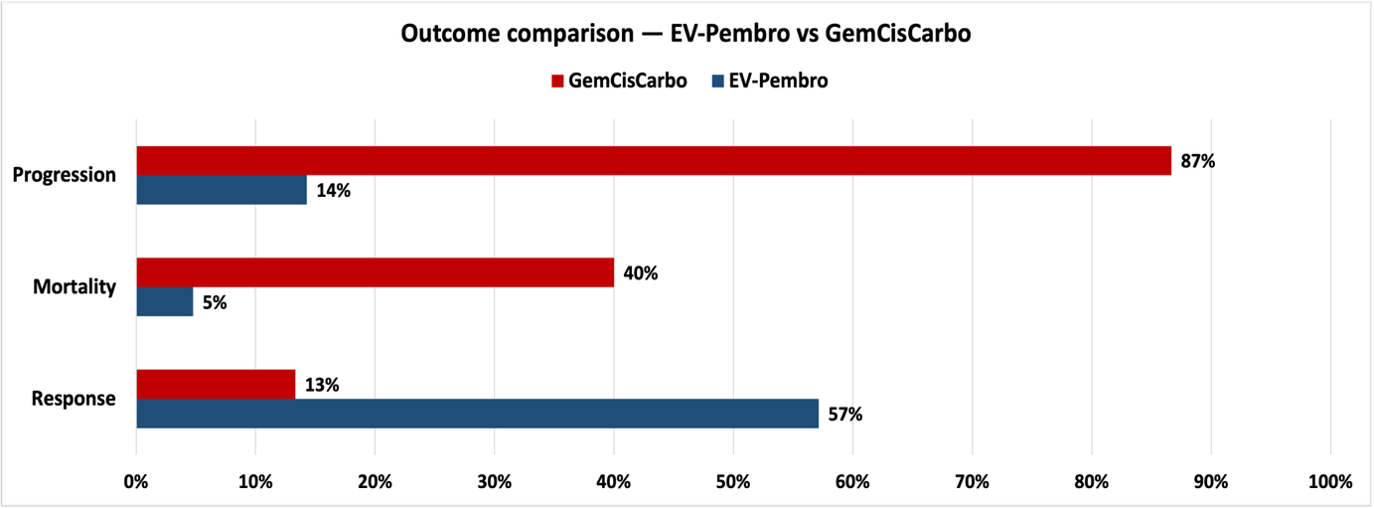
In total we had 21 EVP patients against 15 GemCisCarbo patients. Response rate was 57% vs 13% (RR 4.3, p=0.014), mortality 4.8% vs 40% (RR 0.12, p=0.013), and disease progression 14% vs 87% (RR 0.16, p<0.001), respectively. The overall toxicity burden showed 15 of 21 patients (71%) experienced at least one toxicity, with 24 total toxicity occurrences recorded; 6 patients (29%) had no toxicity reported. Skin toxicity was the most common toxicity at 8 patients (38%), followed by peripheral neuropathy (5 patients, 24%) and adrenal insufficiency (3 patients, 14%). Most events were low-grade severity (Grade 1–2) and many patients had multiple overlapping toxicities (e.g. skin & neuropathy combinations), with only isolated higher-grade events noted (e.g. one Grade 3 immune-related skin toxicity).
Conclusions
EVP demonstrates significantly better response, survival, and progression outcomes than GemCisCarbo across a well-matched population in our experience. Toxicity was common but largely low-grade and manageable, dominated by skin and neuropathy effects, with roughly a third of patients experiencing no toxicity at all. Limitations included a small sample size and immature follow up due to the recency of EVP approval in the UK. Long term follow-up to obtain 5-year survival rates and compiling data across multiple UK centres would be the next step.