Abstract Code: IUC26557-90
Retrospective Review of a Prostate Brachytherapy Case cohort Conducted in Botswana: Clinical Outcomes and Adverse Events
A. Bunga 1, B. Molatodi 2, R. Tapera 3, P. Vuylsteke 3
(1) Juliant Medical Investments, Gaborone - Botswana, (2) Princess Marina Hospital, Gaborone - Botswana, (3) University of Botswana, Gaborone - Botswana
Background
Data on prostate brachytherapy outcomes from sub-Saharan Africa remain limited. We evaluated oncological outcomes and adverse events following low-dose-rate (LDR) prostate brachytherapy in Botswana.
Methods
We conducted a retrospective cohort study of men with localized prostate cancer treated with I-125 LDR brachytherapy between January 2023 and early 2025 at a single centre in Gaborone, Botswana. The primary endpoint was biochemical progression-free survival (bPFS), defined using the Phoenix criterion (PSA nadir + 2 ng/mL). Secondary endpoints included lower urinary tract symptoms (LUTS), rectal toxicity, and erectile dysfunction.
Results
Seventy-four patients were included. Mean age was 64.4 years (SD 7.6). Most patients were Black African (82.4%). Risk distribution comprised low-risk (8.1%), favourable intermediate-risk (13.5%), unfavourable intermediate-risk (39.2%), and high-risk disease (39.2%). Median baseline PSA was 10.8 ng/mL (IQR 7.2–24.8).
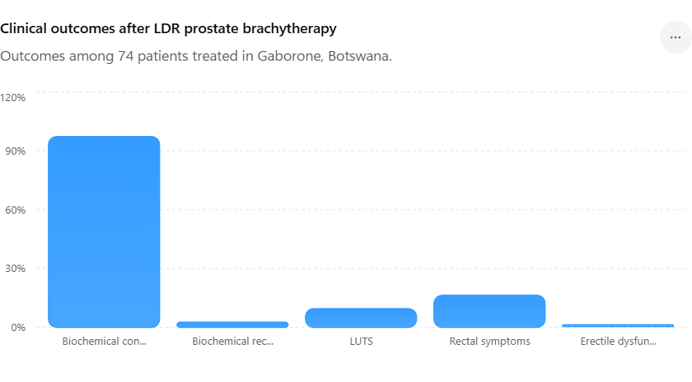
At a median follow-up of 25 months (range 6–36), biochemical recurrence occurred in 2 patients (2.7%), corresponding to an overall bPFS of 97.3%. Kaplan–Meier analysis demonstrated excellent disease control across all risk groups. No clinicopathological factor significantly predicted recurrence on multivariable Cox regression, likely due to the low event rate.
Treatment-related toxicity was uncommon. LUTS occurred in 7 patients (9.6%), rectal symptoms in 12 (16.4%), and erectile dysfunction in 1 (1.4%). Older age independently predicted rectal symptoms (OR 2.54, 95% CI 1.13–5.71).
Conclusions
LDR prostate brachytherapy achieved excellent early biochemical control with low toxicity in this Botswana cohort. Outcomes were comparable to those reported internationally and support continued expansion of brachytherapy services in resource-constrained African settings.
Figure 1. Biochemical progression-free survival following LDR prostate brachytherapy in Botswana
Figure legend: Clinical outcomes among 74 patients treated with I-125 LDR prostate brachytherapy in Botswana. Biochemical progression-free survival was 97.3% at a median follow-up of 25 months. Treatment-related toxicity was uncommon.
Clinical outcomes after LDR prostate brachytherapy