
Abstract Code: IUC26590-87
Outcomes of Novel Systemic Therapies in Advanced Upper Tract Urothelial Carcinoma: A systematic Review and Meta-Analysis
A. D'arienzo 1, D. Incognito 2, S. Facchini 3, C. Barraco 1, A. Nicastro 1, M. Berretta 4, G. Facchini 1
(1) Oncology Unit, S. Maria Delle Grazie Hospital, Pozzuoli, Naples - Italy, (2) PhD Student in Translational Molecular Medicine and Surgery, Department of Clinical and Experimental Medicine, University of Messina, 98122 Messina - Italy, (3) Experimental Clinical Abdominal Oncology Unit, Istituto Nazionale Tumori- IRCCS-Fondazione G. Pascale, Naples - Italy, (4) Department of Clinical and Experimental Medicine, University of Messina - Italy
Background
Advanced upper tract urothelial carcinoma (UTUC) differs clinically and biologically from bladder carcinoma. Treatment recommendations are largely extrapolated from trials enrolling predominantly lower-tract disease. We performed a systematic review and meta-analysis to assess whether contemporary systemic therapies improve survival in locally advanced or metastatic UTUC.
Methods
We searched PubMed, EMBASE, and major oncology meeting abstracts from Jan 2014 to March 2026. Randomized trials comparing immune checkpoint inhibitors, antibody-drug conjugates, targeted agents or antiangiogenic therapies with chemotherapy or best supportive care were eligible. Hazard ratios (HRs) for overall survival (OS) and progression-free survival (PFS) in UTUC subgroups were pooled using random-effects inverse-variance models.
Results
A number of 45 randomized trials were eligible, but 30 (67%) did not report UTUC-specific survival outcomes. Fifteen trials, including 10,824 patients overall and 2,897 with UTUC, were quantitatively synthesized. UTUC representation ranged from 11.2% to 37.7% in non-biomarker-selected studies. No dedicated trial was restricted to advanced UTUC, underscoring a major evidence gap. In first-line treatment, novel combinations significantly improved OS in UTUC (pooled HR 0.73, 95% CI 0.62–0.85; I²=8.7%) and PFS (HR 0.62, 95% CI 0.46–0.84; I²=71.3%) versus platinum-based chemotherapy. Antibody-drug conjugate plus immunotherapy combinations produced the largest effects. Avelumab maintenance showed numerical but non-significant benefit in UTUC (OS HR 0.90, 95% CI 0.59–1.39; PFS HR 0.85, 95% CI 0.60–1.21). In later lines, novel therapies did not significantly improve OS over chemotherapy (HR 0.91, 95% CI 0.78–1.06). The most pronounced OS benefit was observed with erdafitinib in FGFR2/3-altered, ICI-pretreated UTUC (THOR cohort 1; HR 0.34, 95% CI 0.18–0.64).
Conclusions
Patients with advanced UTUC derive a first-line survival benefit from modern combination therapies comparable to that observed in unselected urothelial carcinoma populations. ADC–immunotherapy combinations appear the best treatment option. In later treatment lines, a biomarker-driven strategy is essential to identify patients most likely to benefit from targeted therapies.
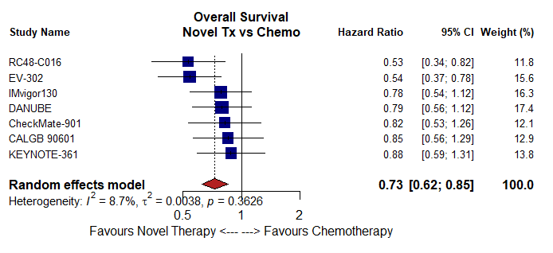
Figure 1. Pooled OS HR for treatment combination in first-line UTUC subgroup