Abstract Code: IUC26597-94
Longitudinal Trends in Androgen Receptor Pathway Inhibitor Prescribing for Metastatic Prostate Cancer in England Between 2013-2025 Using Real-World Data from the NHS England Prior Approval System
J.K.H. Liu 1, A. Cook 1, J. Dodkins 1, E. Mayne 1, A. Nathan 1, J. Nossiter 1, M.A. Parry 1, S. Sukumar 1, R. Fernley 2, J. Hill 2, G.L. Banna 3, M.G. Parry 1, A.C. Tree 4, N.W. Clarke 5, J. Van Der Meulen 6
(1) National Cancer Audit Collaborating Centre (NATCAN), Clinical Effectiveness Unit (CEU), Royal College of Surgeons of England, London – United Kingdom, (2) Medicines Negotiation and Managed Access, Medicines Value and Access, NHS England, London – United Kingdom, (3) Department of Oncology, Portsmouth Hospitals University NHS Trust, Portsmouth – United Kingdom, (4) The Royal Marsden NHS Foundation Trust and The Institute of Cancer Research, London – United Kingdom, (5) The Christie and Salford Royal NHS Foundation Trusts, Manchester – United Kingdom, (6) Department of Health Services Research and Policy, Faculty of Public Health and Policy, London School of Hygiene & Tropical Medicine (LSHTM), London – United Kingdom
Objective: Androgen receptor pathway inhibitors (ARPIs) are a standard of care in first-line systemic treatment intensification of metastatic hormone-sensitive (mHSPC) and metastatic castrate-resistant (mCRPC) prostate cancer, but national prescribing trends over time remain incompletely described. Data from the NHS England Prior Approval System (NHSE PAS), currently provided by Blueteq, represents a novel independent data source which captures treatment approvals of high-cost cancer drugs across multiple tumour types. We used aggregate-level data from the NHSE PAS to assess temporal patterns of ARPI prescribing in England between 2013-2025.
Methods: Datasets were obtained via request from the Medicines Value and Access function, NHSE. Data items comprised: ARPI subtype (Abiraterone, Apalutamide, Darolutamide, Enzalutamide), year (quarters), disease setting (mHSPC vs mCRPC) and age (<75 years vs ≥75 years). Data points of less than 10 were suppressed to avoid patient identification.
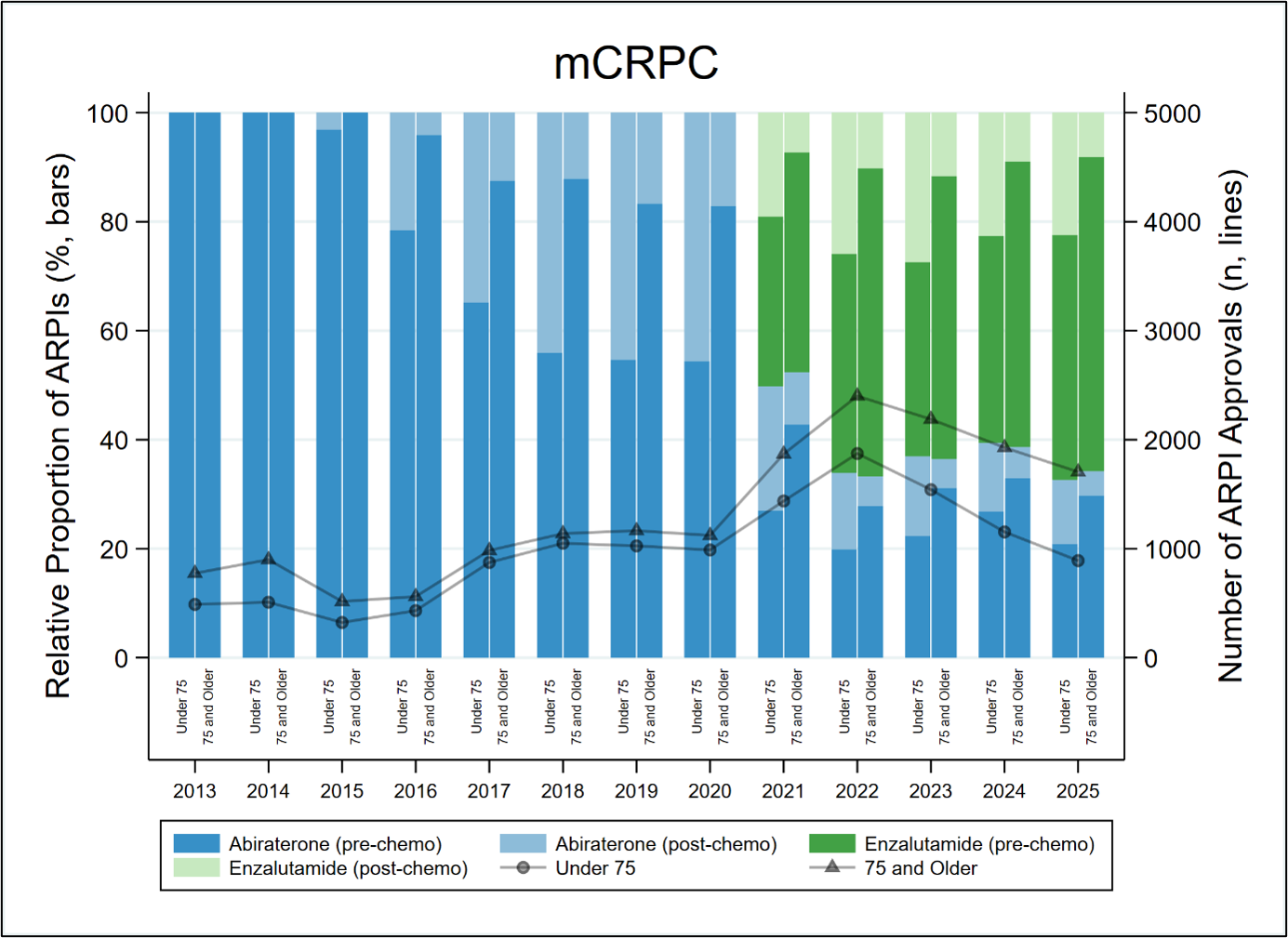
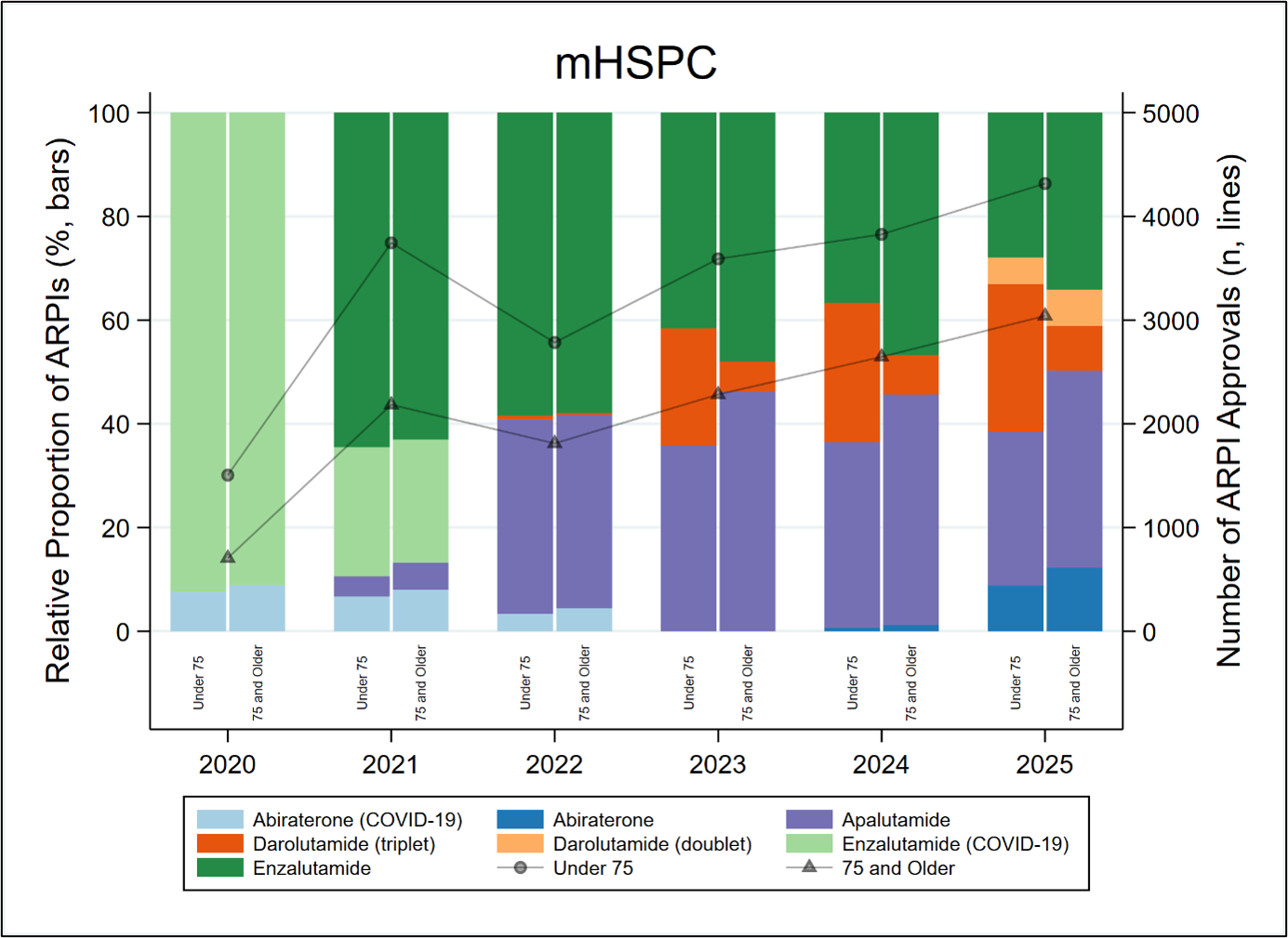
Results: 68,039 ARPI approvals were identified in the NHSE PAS between 2013-2025. Between 2022-2025, ARPI approvals increased by ~60% for mHSPC and decreased by ~40% for mCRPC. In mHSPC, greater use of triplet therapy (Darolutamide+Docetaxel+ADT) was observed in patients <75 compared to ≥75 between 2023-2025 in those who received an ARPI (28% vs 9% in 2025) (Figure 1a). In mCRPC, the utilisation of ARPIs pre-chemotherapy was greater compared to ARPIs post-chemotherapy across the study period, particularly in patients ≥75 (Figure 1b).
Conclusions: The NHSE PAS provides a novel tool to describe the evolving trends in ARPI prescribing in different disease settings (mHSPC and mCRPC) in England. These trends reflect the evolving patterns of ARPI utilisation across time, consistent with clinical trials evidence and approval of ARPIs in routine clinical practice. Age-related differences are also observed which has potential implications for systemic treatment sequencing, particularly in older patients.
Figure 1: ARPI approvals by disease setting and age group.
a.
b