Severe immune checkpoint inhibitor toxicity drives additional costs
- Khanjra 1, M. Emmerich 2, J. Larkin 1, Z. Tippu 1, S. Turajlic 3
(1) Skin and Renal Unit, The Royal Marsden NHS Foundation Trust, London – United Kingdom, (2) Cancer Dynamics Laboratory, The Francis Crick Institute, London – United Kingdom, (3) Cancer Dynamics Laboratory, CRUK Manchester Institute, Manchester – United Kingdom
Objective: Immune checkpoint inhibitors (ICIs) are widely used, but immune-related adverse events (irAEs) may require complex and costly management. We quantified healthcare resource utilisation and estimated direct additional costs associated with irAEs in patients receiving first-line ICIs.
Methods: A retrospective resource-use and cost analysis used data from patients receiving standard-of-care ICIs who were recruited to the prospective observational EXACT study (NCT 05331066). irAEs were categorised by organ system and severity using Common Terminology Criteria for Adverse Events (CTCAE) grade. Evaluated resource use included emergency department attendances, acute oncology service contacts, additional face-to-face and telephone outpatient appointments, inpatient and intensive care days, investigations, procedures and immunosuppressive drug use. Costs were estimated from a UK healthcare provider perspective using NHS England national unit costs, with drug costs taken from the British National Formulary (BNF). One overseas episode was excluded from the base-case analysis. Results are presented as costs, proportions, means and medians with interquartile ranges.
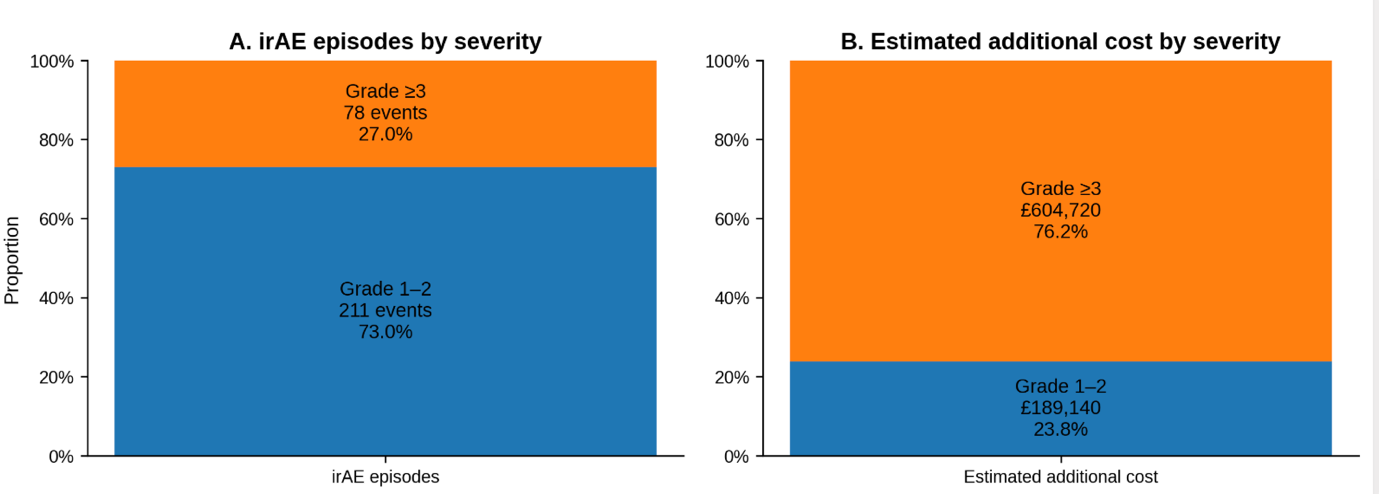
Results: Overall, 289 analysable irAE episodes were identified among 132 patients. Grade ≥3 irAEs accounted for 78/289 events (27.0%). Resource utilisation included 26 emergency department attendances, 298 acute oncology service contacts, 468 additional face-to-face outpatient appointments, 264 additional telephone appointments, 481 inpatient days and 38 intensive care days. Base-case estimated direct additional cost was £793,859.55, with mean cost £2,746.92 per irAE and median cost £424 (IQR £0–£1,796). Drug costs contributed £117,975.55 (14.9%). Grade ≥3 irAEs accounted for £604,719.55 (76.2%) of total estimated cost. Gastrointestinal toxicity was the dominant cost driver. Sensitivity analyses excluding drug or procedure costs and varying proxy-costed items preserved the disproportionate cost burden of severe irAEs.
Conclusion: In this ICI-treated cancer cohort, severe irAEs represented a minority of episodes but drove most estimated additional expenditure, highlighting a modifiable cost burden. Gastrointestinal toxicity, inpatient care, intensive care and escalation immunosuppression were principal cost drivers. These findings support proactive surveillance, early specialist intervention and multidisciplinary pathways to reduce avoidable treatment escalation and optimise resource use as ICI indications expand.
irAE event frequency and estimated additional cost burden by severity