
Abstract Code: IUC26668-93
Clinicopathological Features, Treatment Patterns and Outcomes in Small Cell Carcinoma of the Prostate and Urinary Bladder: A Retrospective Study from an Indian Tertiary Care Centre
- Sharma 1, M. Chettri 1, M. Pallati 2, R. Bisht 1, P. Pandey 2, R. Jain 2, S. Panaiyadiyan 3, P. Singh 3, B. Nayak 3, A. Singhal 4, A. Sharma 5, A. Narwal 6, S. Kaushal 6, R. Kumar Sahoo 2, A. Batra 2
(1) Department of Medical Oncology, All India Institute of Medical Sciences, National Cancer Institute, Jhajjar, Haryana – India, (2) Department of Medical Oncology, All India Institute of Medical Sciences, New Delhi – India, (3) Department of Urology, All India Institute of Medical Sciences, New Delhi – India, (4) Department of Nuclear Medicine, All India Institute of Medical Sciences, National Cancer Institute, Jhajjar, Haryana – India, (5) Department of Radiation Oncology, All India Institute of Medical Sciences, National Cancer Institute, Jhajjar, Haryana – India, (6) Department of Pathology, All India Institute of Medical Sciences, New Delhi – India
Background: Small cell carcinoma of the prostate (SCCP) is a rare (<1%) and highly aggressive neuroendocrine malignancy associated with poor prognosis and limited responsiveness to androgen deprivation therapy. Platinum-based chemotherapy remains the standard treatment, but responses are often short-lived. Evidence is limited to small retrospective studies.
Objective: To describe the clinicopathological characteristics, treatment patterns, and survival outcomes of patients with small cell carcinoma of the prostate and urinary bladder treated at a tertiary care centre.
Methods: Clinicopathological characteristics, treatment patterns, and overall survival (OS) were evaluated retrospectively. Survival was estimated using the Kaplan–Meier method.
Results: Fourteen patients were included. The median age was 69.5 years (range, 35–81), and the mean duration of illness was 7.8 months (range, 1–48). Eleven patients (78.6%) had a prostatic primary and three (21.4%) had primary small cell carcinoma of the urinary bladder. Histology showed pure prostatic small cell carcinoma in three patients, mixed adenocarcinoma and small cell carcinoma in eight, and bladder small cell carcinoma in three. Lymph node (85.7%), bone (57.1%), and visceral (50.0%) metastases were common. Lower urinary tract symptoms were the predominant presentation. All patients received first-line chemotherapy, predominantly platinum-based regimens, while nine (64.3%) also received androgen deprivation therapy. Four patients received second-line treatment and one received third-line therapy. No grade ≥3 treatment-related toxicities or treatment discontinuations were documented. Kaplan–Meier analysis demonstrated a median OS of 11.6 months. Seven patients (50.0%) died during follow-up, with most deaths occurring within the first year of diagnosis.
Conclusion: Small cell carcinoma of the prostate and urinary bladder is an aggressive malignancy characterized by advanced disease at presentation, high metastatic burden, and poor survival despite multimodality treatment. Although limited by the small sample size, this study adds to the scarce Indian literature and highlights the need for prospective multicentre studies to optimize management and improve outcomes.
Keywords: Small cell carcinoma; prostate; neuroendocrine; urinary bladder; retrospective; chemotherapy
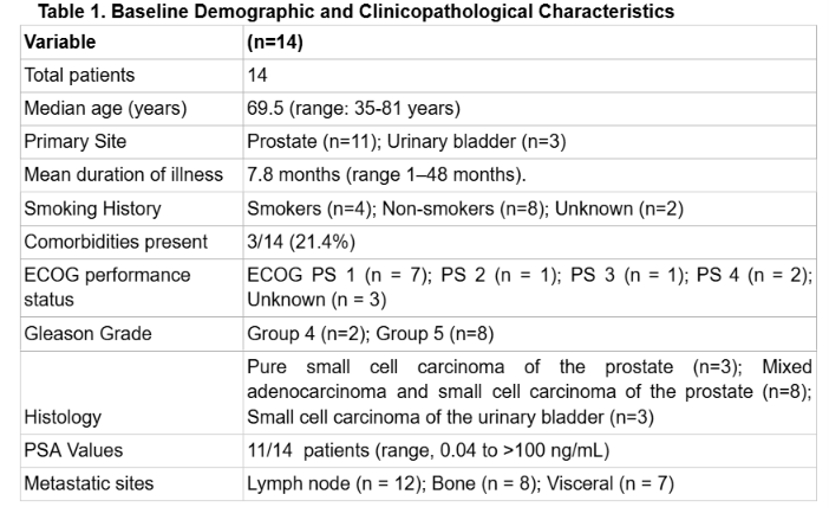
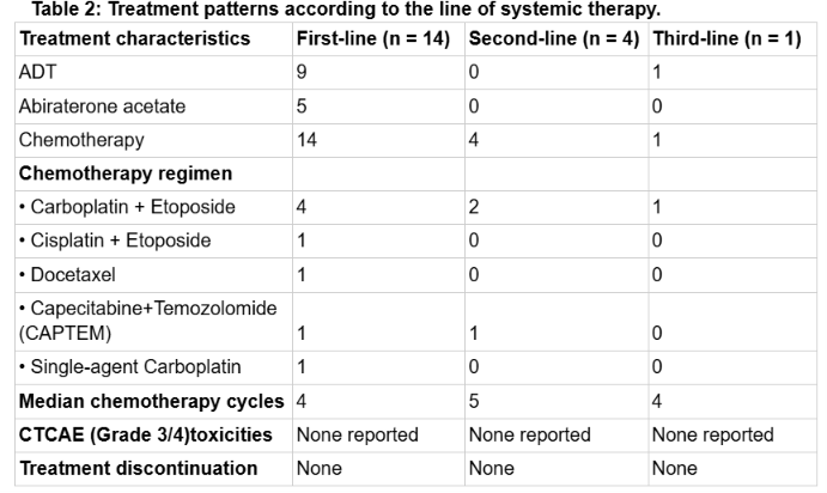
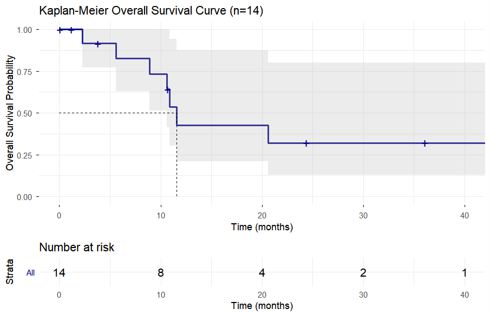
Figure 1: Kaplan–Meier curve for overall survival (OS) in patients demonstrated a median overall survival of 11.6 months.